
Search Suffolk Resilience

30 Days 30 Ways Campaign
There are a range of resources and services available across Suffolk to support your mental health and wellbeing like the one on Healthy Suffolk website: https://lnkd.in/egYutRxc.
Mental Health Safety Planning from Healthy Suffolk, offers practical guidance to help you prepare strategies for managing your mental wellbeing during difficult periods. https://lnkd.in/e8474tV6
Suffolk InfoLink, provides information and signposts to services supporting children and young people’s emotional wellbeing: https://lnkd.in/edG-7bW5
‘Well Minds’ is a booklet packed with information and advice to ensure good mental health: https://lnkd.in/etuhnimH
To get urgent mental health support, please visit: https://lnkd.in/eA5fBqba
About the Campaign
30 Days 30 Ways is a September awareness campaign that encourages individuals, families, and communities to take simple actions to improve their emergency preparedness and resilience. Through a series of daily tips, challenges, and resources, the campaign aims to make preparedness easy, practical, and accessible for everyone.
Each day highlights a different aspect of preparedness, covering topics such as severe weather, flooding, power outages, cyber security, communication plans, first aid, emergency supplies, and community support. Participants are encouraged to follow the daily challenges, learn more about local risks, and take practical steps that can help protect themselves, their families, and those around them.
More information and resources on each theme will be shared throughout the month below.
-
Day 1: Know your Risk
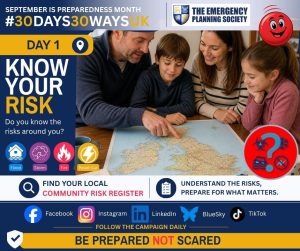
Understanding the risks that could affect your home, workplace or community is the first step towards becoming more resilient. In Suffolk, risks can include flooding, severe weather, power outages, transport disruption and cyber incidents.
Take a few simple steps today:
- Check the Suffolk Community Risk Register below.
- Review or create a Household Emergency Plan.
- Update important contact details.
- Sign up for relevant alerts and warnings, such as flood alerts.
Helpful Resources
Prepare Campaign: prepare.campaign.gov.ukCheck Your Flood Risk: check-for-flooding.service.gov.uk
Community Risk Register -
Day 2: Power Cut Preaparedness
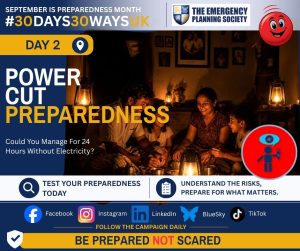
Power cuts can happen unexpectedly due to severe weather, infrastructure faults, or accidental damage to power lines. While many outages are short, some can last longer and affect heating, lighting, communications, and food storage. Today’s challenge is simple: check that you have a working torch in an easy-to-reach place, spare batteries available, and a charged power bank ready to use if needed.
Remember to save 105 in your phone to report a power cut and check in on neighbours, friends, and relatives who may need extra support.
-
Day 3: Cyber Safety
Cybercrime and fraud continue to affect individuals and organisations every day, but taking a few simple precautions can make a significant difference:• Use strong, unique passwords for every account.• Enable two-factor authentication (2FA) wherever possible.• Where supported, consider using passkeys instead of passwords.• Keep devices, apps and software up to date.• Be cautious of unexpected emails, links and attachments.• Check website addresses carefully and only use secure sites that begin with https://.• Be extremely wary of unexpected requests for money.• Know how to report cybercrime. For ongoing incidents call 101. To report fraud, visit hereVisit Cyber Aware for online security advice.Suffolk Constabulary’s website has a number of steps you can take to reduce the risk of cybercrimeFor businesses, a cyber-attack can impact finances, operations, public trust and reputation. The Cyber Action Toolkit provides practical, bite-sized steps to help organisations improve their cyber resilience and better protect themselves against cyber threats. Whether you’re a small business, charity or larger organisation, the toolkit offers clear, actionable guidance to help reduce risk and build stronger cyber security practices.Cyber Action Toolkit
-
Day 4: Space Risk and Planetary Defence
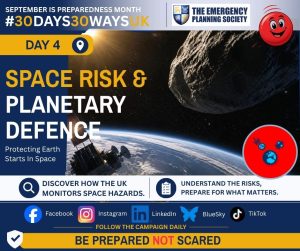
Space risk is often associated with rare catastrophic events, but its relevance to resilience is much broader. We depend on satellites for communications, navigation, weather forecasting and critical infrastructure. Space weather presents an equally important challenge. Severe solar events can disrupt satellite services, communications networks, aviation, navigation systems and electricity infrastructure. As a result, forecasting, early-warning capabilities and coordinated response planning are increasingly important components of national resilience strategies
From monitoring Near Earth Objects to preparing for severe space weather, science, forecasting and international collaboration play a vital role in strengthening resilience and managing risks that originate beyond our planet.
For today, explore the UK Government’s National Space Strategy and consider:
National Space Strategy- How space capabilities support national resilience.
- How Near Earth Objects are monitored and assessed.
- The potential impacts of severe space weather.
- Why international collaboration is essential for managing global space risks.
-
Day 5: Wildfire Aware
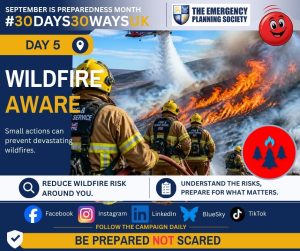
Wildfires can start easily and spread quickly, especially during hot, dry weather. In the UK, grassfires and wildfires can put homes, wildlife and communities at risk, but many are preventable.
Responding to WildfiresSimple actions, such as disposing of cigarettes safely and avoiding open fires or disposable BBQs in the countryside, can help reduce the risk.
Learn how to prepare for and stay safe during wildfires below
-
Day 6: Flood Aware
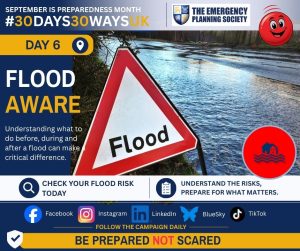
Flooding is one of the UK’s most common natural hazards and can happen as a result of heavy rainfall, overflowing rivers, coastal flooding or surface water.
Being aware of your flood risk before an incident occurs can give you valuable time to prepare and help protect your home, loved ones and belongings.
Today’s challenge:
- Check your flood risk using the official flood information service.
- Sign up for flood warnings:
- Think about the important items you would need to protect or move in the event of flooding.
- Share this information with family members, friends and neighbours.
Remember: Never walk, cycle or drive through floodwater. Just 30cm of moving water can be enough to move a vehicle.
-
Day 7: Trusted Information
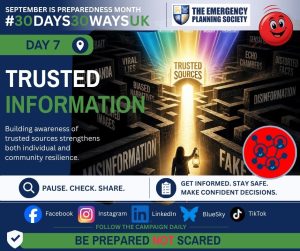
During an emergency, reliable information is essential. Rumours and misinformation can spread quickly online, causing confusion and leading to unsafe decisions. Before sharing information, take a moment to check that it is accurate, up to date and from a trusted source.
Top tips:
- Verify information before sharing it.
- Read beyond the headline and check the source.
- Follow a range of trusted news and official channels.
- Report misinformation where appropriate.
-
Day 8: Scams and Fraud

Scams and Fraud can happen to anyone. They can arrive in an email, a text message, a phone call, on social media, or even through a knock at the door. Scammers often use urgency, fear, or tempting offers to persuade people to hand over personal information. That’s why it’s important to stop, think and check before taking action.
For today’s theme:
Visit Suffolk County Council’s scams webpage for advice on spotting scams and reporting concerns
Help protect your community from doorstep fraud by nominating your street as a No Cold Calling Zone
A-Z of cyber-crime and fraud is packed with examples so you can recognise scams before they catch you.
UK Government’s ‘Stop! Think Fraud’ Campaign highlights how to spot, prevent, and report scams by pausing to stop, think, and check before acting.
Take your time, ask questions, and check independently before sharing any personal information or making a payment.
-
Day 9: Know who to call
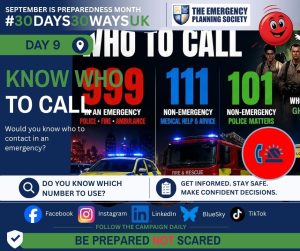 Different services exist for different situations, and knowing which one to use can help get the right assistance to you more quickly.999 – life-threatening emergenciesSuffolk Constabulary’s website highlights how to make a silent 999 call if you are in danger but cannot speak.105-Power Cut101 – non-emergency police mattersNHS 111 – urgent medical advice that isn’t life-threatening0800 111 999 – National Gas Emergency number03457 145 145- Anglian Water for any water supply or sewerage emergency.
 -
Day 10: Mental Health and Well Being
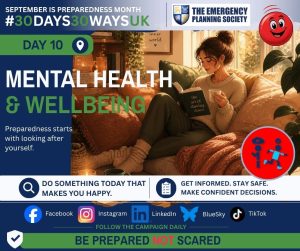
Today we are highlighting the importance of looking after your mental wellbeing and knowing where to find support, both of which are key to building personal resilience.
There are a range of resources and services available across Suffolk to support your mental health and wellbeing like the one on Healthy Suffolk website: Mental Health and Emotional Wellbeing – Healthy Suffolk
Mental Health Safety Planning from Healthy Suffolk, offers practical guidance to help you prepare strategies for managing your mental wellbeing during difficult periods:Mental Health – Safety Planning – Healthy Suffolk
Suffolk InfoLink, provides information and signposts to services supporting children and young people’s emotional wellbeing: Suffolk InfoLink | Service Listings
‘Well Minds’ is a booklet packed with information and advice to ensure good mental health: Well Minds Booklet Version 2 December 25
To get urgent mental health support, please visit: Urgent support – Every Mind Matters – NHS
Get Prepared
